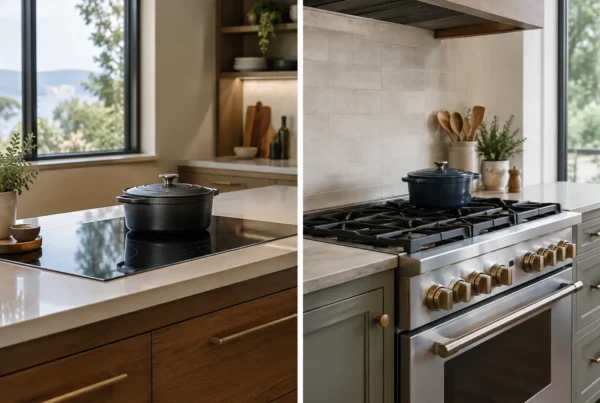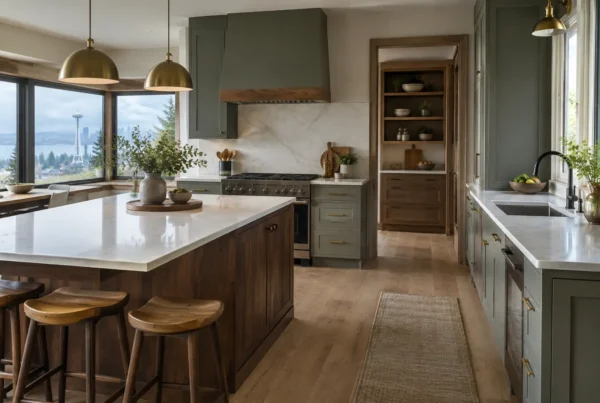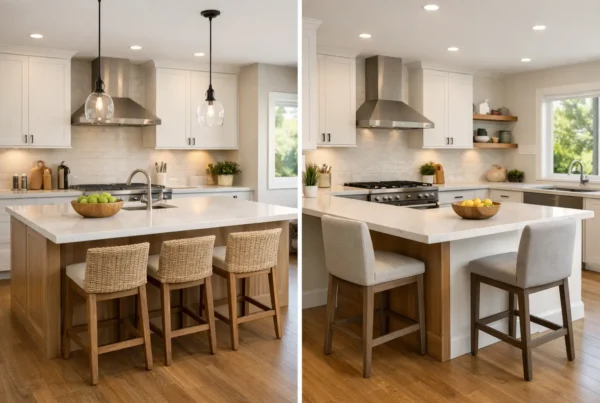
The decision that shapes a family kitchen more than any other is where the refrigerator goes. It sounds like a minor placement question. It isn’t. The refrigerator is the one appliance everyone in the house touches, all day, including the people who are not cooking. Put it inside the cooking zone and every glass of milk becomes an interruption at the stove. We start layout conversations there, because the answer sets up almost everything else in the room.
Most kitchen layout advice sorts rooms into shapes — island, U, L, galley — and stops there. Shapes are a description of a result, not a way of getting to one. A family kitchen has to absorb a specific set of collisions: someone unloading groceries while dinner is already going, a kid doing homework at the counter, two adults trying to work around each other at six o’clock, and a dog underfoot. We design for those collisions first and let the shape follow.
Which layout actually works when four people are in the room?
The honest answer is that the layout matters less than the width of the paths between things. Four people can share a modest kitchen comfortably if the aisles are generous and the zones don’t overlap. Four people cannot share a large kitchen if every task funnels through the same three feet of floor.
What we look for is whether someone can cross the room without walking through the cook’s working triangle. In a lot of Seattle houses that means the main circulation route — back door to hallway, or garage to dining room — cuts straight across the range wall. Rerouting that path, sometimes by moving a single doorway, does more for daily life than adding cabinets. We write about the mechanics of that in more depth in our guide to how we place kitchen work zones and clearances.
Islands earn their space when they give a second person somewhere to stand that is not the cook’s counter. They lose their value the moment they narrow an aisle to the point where the dishwasher door blocks the room. That is a measurable thing, not a matter of taste, and it is why we lay out the island last — after the appliances, the sink, and the doorways are settled.
Where should the refrigerator and the snack zone go?
We push the refrigerator toward the edge of the kitchen, on the side closest to wherever the family enters. Everything a child or a guest reaches for on their own goes with it: glasses, water, cereal, fruit, lunch supplies. That cluster becomes a small self-serve zone that anyone can use without stepping into prep territory.
It’s a quiet change that removes a surprising amount of friction. The cook stops getting interrupted. Kids get more independent because the things they need are at their height and outside the danger zone. And when the kitchen is open to a family room, as it often is after a wall comes out, the snack zone gives visitors an obvious place to stand that isn’t the range.
Can homework and dinner prep really share an island?
They can, but only if the island is planned for two different postures. Homework wants a seat with knee space, a surface at a comfortable height, and light that doesn’t come from behind the person’s head. Prep wants counter depth, an outlet, and proximity to the sink and the trash pull-out.
Where families get into trouble is with a single flat run of counter and stools tucked under the working side. Papers end up in the onion peelings. What works better is an island with a defined seating end — often a return or a slight offset — so the seated zone is physically out of the prep path. Where the room allows, we like seating on the end nearest the dining space rather than on the long side facing the range.
Lighting matters here more than people expect. In a Seattle winter, a north-facing kitchen loses usable daylight by mid-afternoon. A seated homework spot lit only by a ceiling can and a distant window will be in shadow every evening from November through February. We plan a dedicated fixture or an under-cabinet run over that spot as part of the layout, not as an electrical afterthought.
What happens to the groceries between the car and the counter?
This is the test we come back to constantly. Many older Seattle homes — Craftsman bungalows in Gatewood and Genesee, mid-century houses in Seaview with a tuck-under garage on a sloped lot — put the parking a full flight of stairs below the kitchen, or at the far end of the house entirely. Someone is carrying four bags up a set of stairs and needs a place to set them down within a step or two of the door.
A landing surface near the entry point is one of the highest-value square feet in a family kitchen. It can be a short counter run, the end of an island, or a purpose-built drop zone with a drawer for keys and mail. Pair it with pantry storage on the same side of the room, and the whole unload sequence happens in one place instead of tracking across the floor three times.
The same logic applies to trash and recycling. King County collection means glass, paper, food waste and garbage all need somewhere to live indoors. Planning that into cabinetry at the layout stage is far easier than solving it after the boxes are set.
Does the wall between the kitchen and dining room need to come out?
Often, but not always, and the reason should be circulation rather than fashion. In a 1920s or 1930s Seattle house the kitchen was built as a service room — closed off, tight, with a swinging door to the dining room. Opening it can turn two cramped spaces into one that works for a family. It can also erase the only wall you had for tall storage.
That wall is frequently load-bearing, and in older houses it may also carry plumbing vents or original wiring. Whether it comes out, how far, and what replaces it structurally is something we resolve during design, with the beam sized and the permit path through SDCI understood before anyone signs a construction contract. We would rather you know the full picture while it is still drawings.
What do families regret a year later?
Rarely the finishes. Almost always the flow. The regrets we hear about are aisles that are four inches too tight, a pantry across the room from the refrigerator, an island that everyone walks around instead of gathering at, and a beautiful seating area nobody uses because it faces a wall.
None of those are expensive problems to avoid in drawings. All of them are expensive to fix in framing. That is why our design phase is long and specific — we work through the ordinary Tuesday, not the dinner party — and why our fixed price comes only after the layout is fully resolved. If your household is already in the thick of it, our post on remodeling a kitchen with kids at home covers the scheduling side. At NOR Design & Construction the layout and the build are one contract, so the person who drew the aisle width is the person accountable for it on site — and you can see the range of what that produces on our kitchen remodeling page.
If your kitchen falls apart at six o’clock on a weeknight, that is a layout problem worth taking seriously, and it is exactly what a design consultation is built to unpick. We’ll walk your house, watch how your family actually moves through it, and design around that before we price a thing. Book a consultation with us or call 206-979-3420.