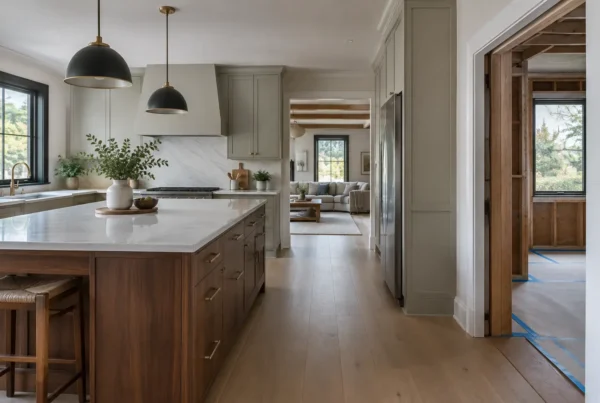
The tile has to be in the building before the tile setter is. That one fact explains more about remodel stress than anything else we could tell you. A trade shows up on a scheduled day to do a specific thing, and if the material is not there, or the decision behind the material has not been made, that trade leaves. They do not come back the next morning — they come back when their next opening is, and everything behind them slides too.
Homeowners usually expect that the hard part of a remodel will be the noise, the dust, and the disruption. Those are real and we will not pretend otherwise. But in our twenty years of doing this in Seattle, the thing that actually wears people down is not the mess. It is uncertainty: not knowing what is happening this week, not knowing what the final number is, and not knowing who to call.
What actually causes the stress?
Two things, and almost everything else is downstream of them.
The first is decisions that are still open once construction has started. Every unresolved selection becomes a deadline that arrives without warning, usually by phone, usually while you are at work. Choose the grout color today. The vanity you picked is discontinued. We need the tile pattern before Thursday. Each one is small. Twenty of them across four months is what people are describing when they say a remodel took over their life.
The second is divided accountability. When a designer drew the project and a separate contractor is building it, there is a seam, and problems live in seams. The drawing did not anticipate the duct. The cabinet does not clear the window casing. Now two firms are explaining the situation to each other with you in the middle, and you are the only person in the conversation who is paying both of them.
Why does finishing every decision before demolition help so much?
Because it converts a hundred small emergencies into one concentrated period of thinking, at a time when your kitchen still works and you can sleep on a choice.
On our projects, the design phase ends with everything specified — layout, plumbing locations, electrical, cabinetry, tile with grout color and joint width, fixtures by model number, paint by name and sheen. Nothing on the schedule says “to be determined.” That completeness is also what lets us price the project as a fixed bid rather than an estimate, because there are no allowances left holding a place for choices nobody has made.
Two things follow from it during construction, and they are the ones clients notice. Materials can be ordered and staged ahead of the trades that need them, so nobody arrives to a job that is not ready. And the price stops being a live question. A remodel where the total is still moving is a remodel you think about at two in the morning; one where the number was settled before the first wall came down is not. That sequence is the whole logic of our process.
Who do I call when something goes wrong?
Us. One number, one team, and the same people who designed the project.
This is the practical meaning of design-build, and it is worth being concrete about what it removes. There is no question you can ask that lands in a gap between two companies. When something in the field does not match the drawing, the person who drew it is on the same payroll as the person building it, and the resolution happens between them rather than through you. When you want to know whether a change is possible, you get an answer that accounts for both design intent and construction reality, from one source, once.
It also removes an exhausting job most homeowners do not realize they have signed up for otherwise: being the translator. Under separate contracts, you become the only person who has heard both sides of every issue. That is a part-time job on top of your actual one.
What happens when something turns up behind a wall?
It will, sometimes. We work in houses built in the 1920s, 30s and 40s, and they keep things from you. Live knob-and-tube behind plaster. Galvanized supply lines that look fine until they are disturbed. Framing that a previous remodel modified without much ceremony. A sloping West Seattle lot that made someone’s 1950s addition more creative than it should have been.
We will not promise you a clean run behind the plaster, because nobody can see through a wall and anyone who says otherwise is managing your feelings rather than your project. What we can do is reduce the number of them. During design we investigate what is accessible — the panel, the basement framing, what is visible in the crawlspace, what the permit history says — so that fewer conditions are unknown by the time demolition starts.
For the ones that remain, what reduces the stress is speed and clarity. You hear about it the day it is found, with the options and the cost impact, in writing, from one person. Not a rumor from a subcontractor and an invoice three weeks later.
Does any of this make the disruption itself easier?
Partly, and honestly, only partly. You will still be washing dishes in a bathroom sink for a stretch. There will still be a week where the house is loud from eight in the morning. In a wet Seattle winter you cannot stage everything in the driveway and work with the doors open, which makes containment and daily cleanup matter more than people expect.
What planning does change is duration and predictability. Because our selections are finished and our materials are staged, the active construction phase is shorter — that is deliberate, and it is one of the main things we design for. And a known end date is a very different experience from an open one, even if the weeks in between are identical.
The practical side of surviving those weeks — the temporary kitchen, where the microwave goes, how you handle mornings — is covered in our post on daily life during a kitchen remodel.
What can I do on my side?
A few things genuinely help, and they mostly happen before day one.
- Decide with us, early, and then stop shopping. Continuing to browse after sign-off is the most common source of self-inflicted mid-build changes.
- Sort out where life will happen. Where you’ll cook, where the coffee maker lives, where the dog goes when the saw starts.
- Agree on one household decision-maker for day-to-day questions. Not for the big calls — for the small ones that need an answer by noon.
- Say something early when something bothers you. Small concerns raised in week two are easy. The same concern raised in week nine is a change order.
Our companion post on preparing the household before construction starts goes through the rest — packing, pets, parking and the things people forget.
If what is making you hesitate about remodeling is the prospect of living through it, that is a completely reasonable thing to raise first, and it is a design problem as much as a scheduling one. Talk it through with NOR Design & Construction — we’ll show you how the decisions get finished up front and what your months actually look like. Set up a consultation, or call 206-979-3420.