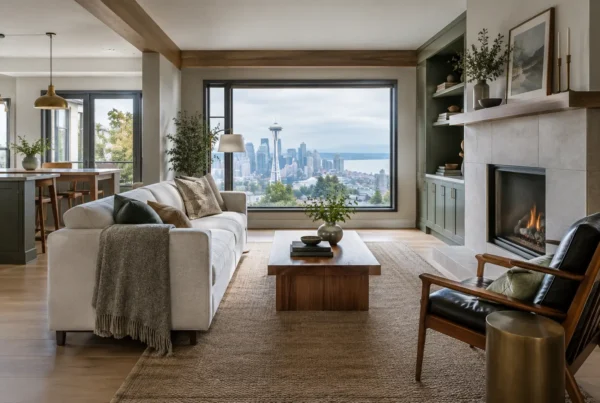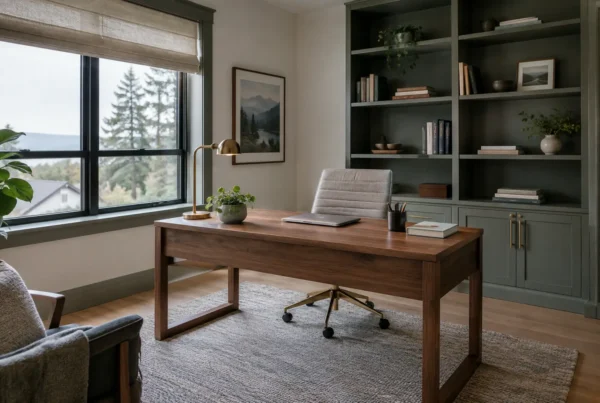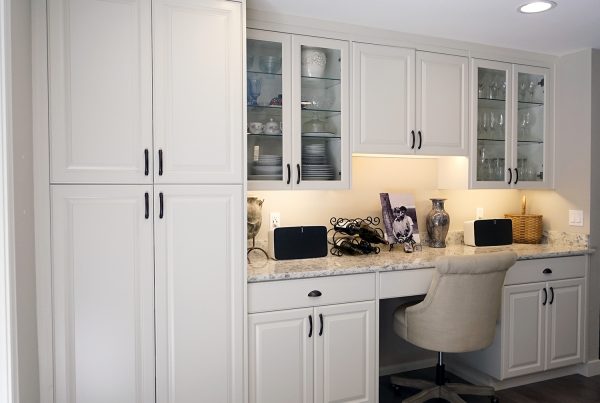
The first material we specify on a project is almost never the one homeowners expect. Not the backsplash. Not the paint. It is usually cabinetry and flooring — the two largest and least changeable surfaces in the room — because every selection that follows has to sit next to them. Choose a tile first and you spend the rest of the project designing a kitchen around a tile.
Material selection is the part of our work that looks, from the outside, like shopping. It isn’t. It is a sequence with a defined beginning and a defined end, run by the same people who drew the plans, and it finishes before we price the construction rather than during it. Here is how it actually runs.
When does picking materials start?
After the plan is settled, not before. We need to know where the range is going, how wide the island is, whether the wall between kitchen and dining room is coming out, and what the ceiling is doing overhead. Those decisions set quantities and sightlines. Selecting a countertop before the island dimension is fixed is guessing at one of the largest single numbers on the page.
There is one thing we lock early anyway: appliances. Appliance dimensions drive cabinet openings, venting routes and electrical circuits, so we settle those while the rest of the finish schedule is still open.
What comes before selection is direction. In the early design meetings we are building a point of view for the house — how formal it wants to be, how much contrast it can carry, whether the goal is to sit quietly inside a 1920s Craftsman or to make a deliberate break from it. Our formal training is in interior design, so this is not a decorating step bolted onto a construction schedule. It is the framework everything else hangs from, and it runs through every project we take on, whether or not a client also hires us for standalone interior design work.
Why do cabinets and floors get decided before tile?
Three reasons, and they all point the same way.
- Area. The biggest surfaces set the tone. A floor and a run of cabinetry are visible from every angle in the room; a backsplash is visible from about three.
- Flexibility. There are hundreds of tiles that will work with a given cabinet color. There are far fewer cabinet colors that will work with a tile you have already fallen for.
- Lead time. Cabinetry is usually the longest item to arrive, and it cannot be ordered until the door style, finish and box construction are final. Holding it up holds up the build.
So we work from large to small: cabinetry and flooring, then countertops, then tile and plumbing fixtures, then lighting fixtures and hardware, then paint. Paint goes last on purpose. Paint can be matched to anything; almost nothing can be matched to paint.
Do I really need to look at samples in person?
Yes, and not because we are old-fashioned about it. Screens are unreliable about the two things that matter most in a finish: undertone and sheen. A white with a green undertone and a white with a pink undertone photograph identically and look nothing alike on a wall next to fir trim.
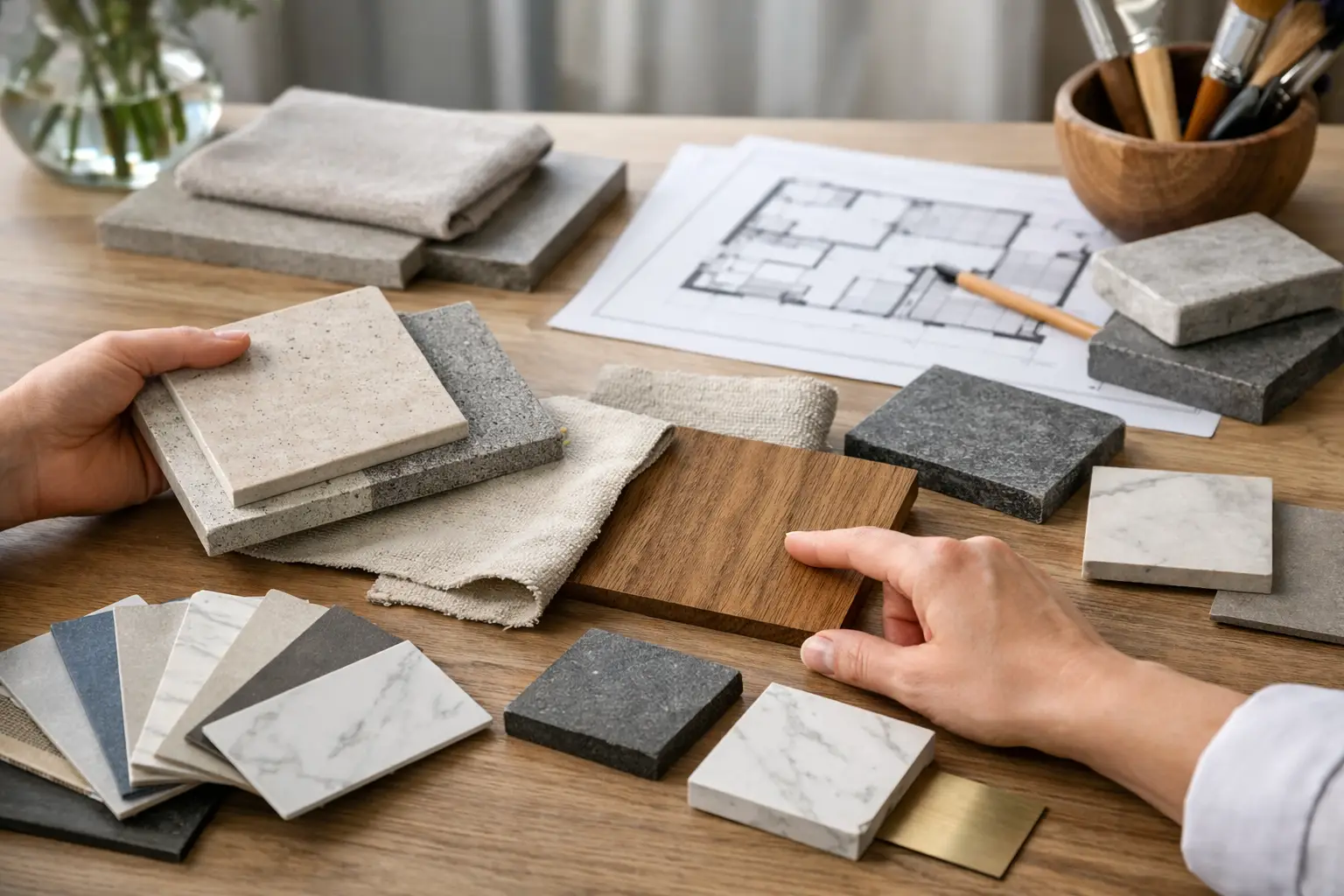
Scale matters too. A two-inch chip of a veined quartz tells you the color and nothing about the movement — whether the veining will read as quiet or as a statement across an eight-foot island. Where a material has pattern, we look at a full slab or a large-format sample before it goes on the schedule.
And samples are reviewed together, never one at a time. We lay the flooring flat on the floor, hold the cabinet door vertical the way it will actually hang, and put the countertop and tile in the same frame. Every finish looks good alone. The question is only ever how it behaves in company.
How do I know a sample will look the same once it’s installed?
This is where Seattle earns its own paragraph. Our winter light is cool, low-angled and often flat for weeks at a time. A warm white that reads creamy under showroom halogen can go distinctly yellow in a south-facing room in July and dull in the same room in January. A cool gray in a north-facing bedroom in Ballard or Wedgwood can drop to something close to blue by mid-November.
So we review samples in the actual room, at more than one time of day, and we look at them under the light we have specified rather than the light that happens to be there now. Because we design the lighting as part of the same project, we know what color temperature the fixtures will put out and can judge the finish against it instead of hoping.
Damp matters as well. Houses here run humid from October through April, and that shapes real decisions: how a matte finish holds up in a bathroom, whether a porous stone belongs on a heavily used surface, how much ventilation a material choice is quietly assuming. Those questions get answered on the schedule, not after the first wet winter.
What does sign-off actually mean?
Sign-off means the finish schedule is complete. That document lists every room and every surface: cabinet species, door style and finish, countertop material and edge profile, tile with grout color and joint width, plumbing and lighting fixtures by model, hardware, paint by name and sheen. Nothing on it says “to be determined.”
That completeness is the whole point, because it is what makes a real price possible. We price a project only after it is fully designed and fully selected, as a fixed bid — and a fixed bid is only honest if the selections behind it are actual products, not placeholders. An allowance is a number that has not been decided yet, and it becomes a bill later, usually at the worst moment. Removing them is one of the main reasons our process puts so much weight on this stage.
What if I change my mind after sign-off?
You can. We will price the change and tell you what it does to the schedule before you decide, and sometimes the change is clearly worth it. But we push hard to finish selections before construction starts because a mid-build change is rarely just a cost. It is a stall. The tile has to be in the building before the tile setter is, and a trade that loses its slot does not simply resume the next morning.
How much of the work you do yourself is up to you. Some clients want to visit showrooms with us and touch everything. Others want a curated pair of options and a recommendation. We can also carry it past the finish line entirely — furnishings, window treatments and styling through our manufacturer partnerships — which is often what separates a room that looks finished from one that looks installed. You can see how far that goes in our kitchen before-and-after work.
Choosing materials is easier when someone has already narrowed the field to things that will work in your rooms, in your light, at your level of use. That narrowing is what a design consultation with NOR Design & Construction begins. Come tell us how you actually live in the house, and we’ll build the selection sequence around it — then give you one fixed price once every choice is made. Book a consultation, or call us at 206-979-3420.