Nothing in our process gets priced until it has been drawn. That single rule determines the order of everything else — when we visit, when we ask you to choose things, when we bring in an engineer, and when we can finally hand you a number you can rely on. Homeowners are often surprised by how much happens before a construction contract exists. That front-loading is deliberate, and it is where most of the value of working this way comes from.
Here is what actually happens, phase by phase, from the first phone call to the day we hand the house back.
What happens in the first conversation?
We talk about how you live, not about products. What is broken about the way the house works right now. Who cooks, who cleans up, where everyone ends up on a Sunday. Whether the plan is to stay for thirty years or ten. Whether there are stairs that are already becoming a nuisance.
We also want to see the house. Photographs help, but a great deal of what matters in Seattle housing stock is only legible in person — where the light actually falls in a north-facing room, how much the floor has moved, whether the addition off the back was permitted, what the crawlspace looks like. Our studio is in West Seattle on California Ave SW, and much of what we design is within a short drive of it, so this is usually easy to arrange.
By the end of that conversation we can tell you whether the thing you’re imagining is realistic in that house, roughly what it would involve structurally, and whether we’re the right firm for it. Sometimes the honest answer is that a smaller project solves the actual problem. We’d rather say so early.
Why does design come before any price?
Because a price for an undesigned project is a guess, and a guess has to protect itself with allowances, exclusions, and the phrase “we’ll figure that out in the field.” We would rather do the figuring out while it is still drawings.
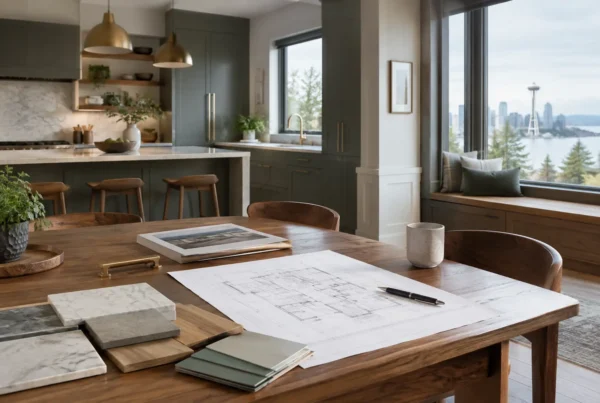
So the next step is a design agreement, and it is a real, standalone piece of work. During design we resolve the layout, the structure, the mechanical routing, the lighting plan, the cabinetry drawn to your specific walls, and the finishes. We field-verify rather than assume — which in a 1920s house means confirming what is actually behind the plaster before we commit a beam size to paper.
If the project touches structure, changes the building envelope, or needs new circuits and plumbing runs, we work out the permit path through Seattle’s Department of Construction and Inspections during this phase too. Permits are much less painful when the drawings are complete and correct going in.
When do we choose materials?
During design, not after it. This is one of the sharpest differences between our process and an estimate-and-allowance approach.
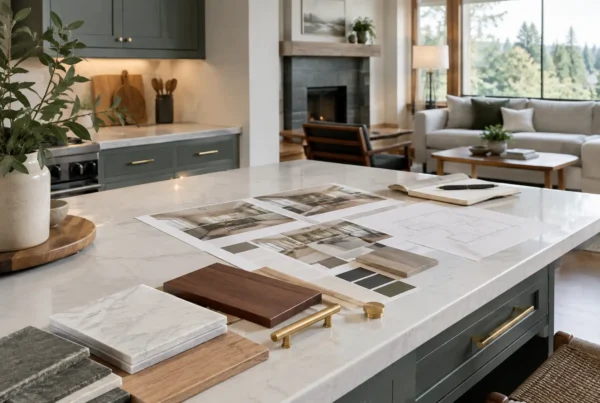
An allowance is a placeholder — a dollar figure standing in for a tile you haven’t picked. The moment you pick the real tile, the placeholder was wrong, and the difference lands on you as a change order. We remove that mechanism entirely by selecting the actual tile, the actual slab, the actual cabinet finish, the actual faucet, before we price anything.
Practically, that means sample sessions with us. We narrow things hard rather than handing you a wall of options, because our training is in interior design and narrowing is the job. We look at samples in your house, under your light, at the time of day you’ll actually be in the room — a decision that looks crisp under showroom halogen can look flat and cold in a Seattle February.
What happens between the finished design and the first day of demolition?
Two things: the bid, and the preparation.
The bid comes first. Once the design is complete, we price that exact project as a fixed bid — a specific scope with specific products, not a range. You review it, you ask questions, and you decide whether to sign a construction contract with a number already in hand. Nobody is committed to building anything until that happens. The reasoning behind this is laid out further in our explanation of what design-build actually means.
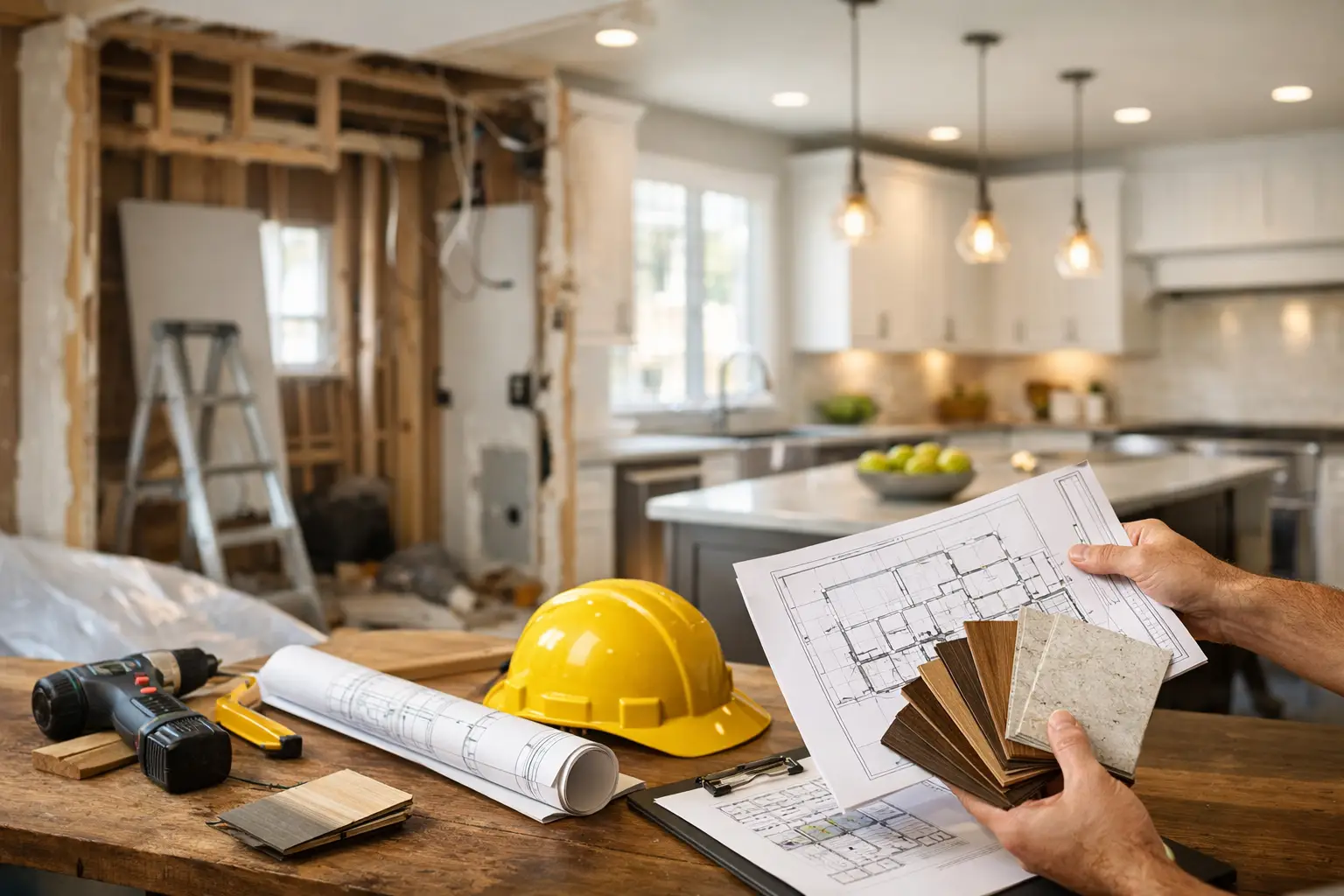
Then comes preparation, which is where the schedule is actually won or lost. Cabinetry gets ordered and goes into fabrication. Appliances are confirmed and, where lead times are long, secured early. Slabs are selected. Permits are in hand. Trades are booked against a real sequence, not a hopeful one. By the time demolition starts, the parts of the project that take the longest to arrive are already on their way.
This is the single biggest reason our active construction phases run shorter than they otherwise would. Most delay on a remodel is not slow work — it is waiting for a decision or a delivery that could have been handled months earlier.
What is construction actually like?
Disruptive. We won’t pretend otherwise. There will be dust, there will be noise, there will be a stretch of weeks without a kitchen or without a primary bathroom, and there will be at least one morning where something unexpected comes out of a wall.
What our process does is contain it rather than eliminate it. You have one point of contact who knows both the drawings and the site — not a designer who hands off to a builder and disappears. Protection goes in before demolition. Work areas are separated from living areas. You know the sequence in advance, so the week the plumbing is opened up isn’t a shock.
When something genuinely unforeseen appears — rotten subfloor under a sink, a wall carrying more than it should be — we bring you a solution and its cost implication in the same conversation, and it is a discussion, not a bill that arrives after the fact.
What happens at the end?
Inspections close out. We walk the project with you and build a punch list — the small, specific things: a drawer that needs adjusting, a paint touch-up, a switch that should be relabeled. We work through that list, then walk it again.
Where you’d like, we keep going past construction. We can furnish and style a finished space through our manufacturer partnerships, so a whole-home project can end with the rooms actually complete rather than empty and waiting.
The whole sequence is laid out in more detail on our design and remodeling process page, and it is the same process whether the project is one bathroom or an entire house. It exists because NOR Design & Construction is one team carrying both halves of the work, which means there is nobody to hand the problem to.
If you want to see how this would apply to your own house, a design consultation is the first phase — no drawings yet, just an honest read on what your home can do and what it would take. We’ll walk the space with you and tell you plainly what we see. Reach out to book one, or call 206-979-3420.