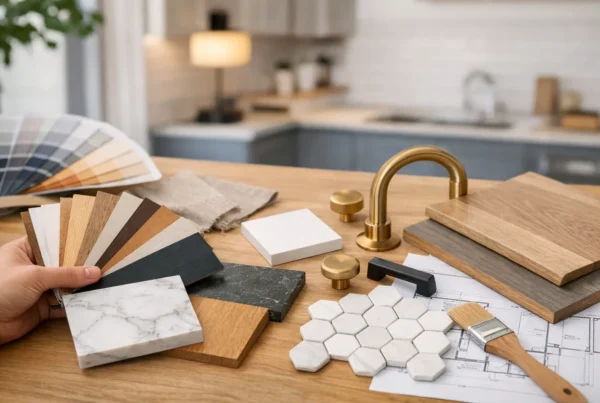
A homeowner sits down with us wanting a greener kitchen and opens with a material: bamboo counters, or recycled glass, or reclaimed fir for open shelves. Those are all real options. But none of them is the decision that will determine how much this kitchen costs the planet, or your household, over the next twenty years.
The largest environmental cost in a kitchen remodel is the remodel itself — the demolition, the hauling, the manufacturing, the freight. Which means the single greenest thing a kitchen can do is last. Everything else we discuss below is measured against that. A cabinet that fails in twelve years is not sustainable no matter what the box is made of, and a beautiful counter that stains in a house where three people cook every night will be replaced long before its material credentials pay for themselves.
What actually makes a kitchen sustainable in this climate?
Seattle houses spend most of the year closed. From October through May, windows stay shut, the furnace runs, and whatever a kitchen produces — steam, grease, moisture from a dishwasher, moisture from a pot of pasta — stays in the house. That single fact reorders the whole sustainability conversation here.
Ventilation is the choice we push hardest on, and it is almost never the one people arrive asking about. A properly sized, properly ducted hood that vents outside is worth more to the health of a Northwest house than any material on the counter. Recirculating hoods, which filter air and blow it back into the room, are a compromise we accept only when a duct run genuinely cannot be made — and we will tell you when that is the case rather than quietly specifying one.
The corollary matters too. Newer, tighter houses and well-insulated remodels need a way for replacement air to enter when the hood is pulling hard, which is why make-up air comes up in almost every high-output range conversation we have. It is unglamorous, it is not free, and it prevents a range hood from depressurizing a house and pulling combustion air backward through a water heater flue.
Are the eco-friendly materials worth what they cost?
Some are. Some are marketing.
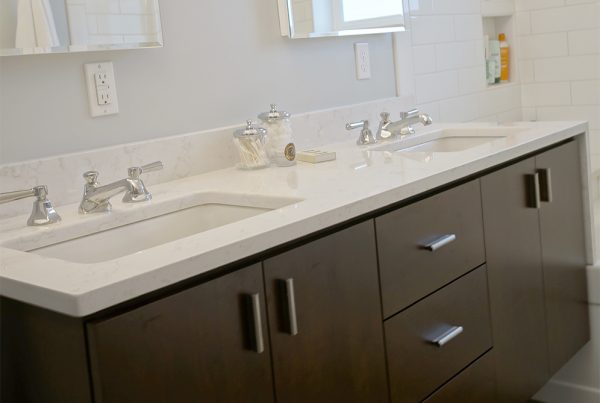
- Plywood cabinet boxes with a low-formaldehyde core. Worth it, on both counts. Plywood boxes survive a wet-climate kitchen and a dishwasher leak in a way particleboard does not, and the air-quality difference in a house you cannot air out for eight months is real.
- Low- and no-VOC paints, finishes and adhesives. Worth it, and inexpensive relative to everything else. This is one of the clearest wins in a Northwest remodel precisely because the house stays closed while the finishes cure.
- Bamboo countertops. Usually not. Bamboo is genuinely renewable, and it belongs in plenty of places, but a wood-based counter in a working kitchen sink zone is a maintenance commitment most households do not want. If a warm natural counter is what you are after, we would rather design a butcher-block island top away from the sink and put something durable where the water is.
- Recycled-content surfaces. Genuinely good when the product is durable in its own right. We evaluate them on performance first and recycled content second — in that order, every time.
- Reclaimed wood. Beautiful for shelving, a beam wrap, a hood surround, an island panel. We are careful about putting it anywhere it takes on standing water.
Should I replace appliances I already have?
Not automatically. Pulling a working refrigerator out of a house and sending it to a recycler so a marginally more efficient one can take its place is not obviously a net gain, and we will say so.
What does change the calculation is a layout change. Once a kitchen remodel moves the appliance wall, changes cabinet dimensions or alters the venting path, the existing appliances often no longer fit the plan — and at that point choosing efficient replacements is simply choosing well. This is also why appliances get selected early with us rather than late. They set cabinet openings, electrical loads, duct sizing and clearances, and a kitchen designed around unknown appliances is a kitchen that will be modified in the field.
Electrification is worth a real conversation here, and Seattle is an unusually good place to have it. Most of the electricity delivered in the city comes from hydropower, so moving cooking off gas has a different climate arithmetic here than it does in much of the country. Induction also happens to be the better appliance for most of the cooks we work with. The honest trade-off is the electrical work: many of the older houses we remodel in West Seattle and Ballard are running on panels that were never sized for an induction range plus a heat-pump water heater plus everything else. That is a real cost, and it belongs in the design conversation rather than surfacing as a change order in week three.
What sustainable work is worth doing while the walls are open?
This is the part homeowners regret skipping, and it never appears on a green-kitchen checklist.
When a kitchen wall in a 1920s bungalow comes down to the studs, you are looking at an exterior wall cavity that may have no insulation at all, at knob-and-tube wiring that has to be dealt with anyway, and at a floor structure you will never see again. Insulating that cavity, air-sealing it properly, and upgrading a leaky original window on that wall costs a fraction of what the same work costs as a standalone project later. It also does more for the comfort of the room in February than any finish selection will.
We plan that work during design, not during demolition, and it appears in your bid as scope rather than as a surprise. If you want the same thinking applied beyond the kitchen, our post on sustainable design choices for a Northwest home covers how these decisions play out across a whole house.
How do we handle this in our own process?
Sustainability is not a package we sell on top of a kitchen. It is a set of decisions made during design, when they are still cheap to make, and it is shaped by what your household actually needs. A family who cooks twice a day and a couple who reheats needs entirely different ventilation, different surfaces and different appliances, and we would rather ask than assume.
Because we run design and construction as one process, the person specifying the low-VOC finish and the person scheduling the ducted hood work for the same firm, on the same drawing set. And because we price only after the kitchen is fully designed, the insulation, the duct run, the panel upgrade and the finish selections are all inside a fixed number before you sign a construction contract. At NOR Design & Construction, none of that lives in an allowance.
If you want a kitchen that is genuinely better for your house rather than better on paper, that is a design conversation worth having early. We will look at how your home is built, what your household actually does in the kitchen, and where the sustainable money is well spent — then price it exactly. Schedule a design consultation with us, or call 206.979.3420.