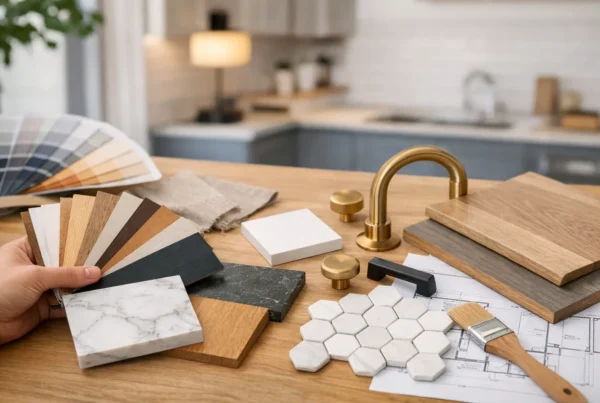
A countertop sample is about the size of a paperback, and it is always shown to you clean, dry, and under lighting chosen to flatter it. Five years into ownership, none of those conditions apply. The surface you actually live with has three or four square feet that carry almost all of the wear: the run beside the sink, the eighteen inches to the left of the range where hot pans land, the landing strip by the refrigerator, and whichever corner has become the place where mail, keys and homework collect.
So when a client asks us which countertop is best, we usually turn the question around. Not which material looks best, but which one you’ll still be happy with after it has a history. That’s a different conversation, and it has clearer answers.
Which part of the counter actually wears out first?
The wet zone, almost always. Water, soap, citrus, wine and coffee all live within arm’s reach of the sink, and so does the front edge, which takes every knock from a pot lid and every drag of a cast-iron pan. Next is the heat zone beside the range. Then the outside corners, which chip because that is what corners do.
Knowing this changes how we specify. A material that is merely acceptable across the whole kitchen but excellent at the sink can be the right answer. Splitting materials on purpose — one surface on the perimeter, another on an island that mostly serves as a gathering place — is often smarter than making one slab do every job. That kind of decision belongs in design, alongside the cabinetry choices you live with every day, because the two get drawn together.
Does engineered quartz really not age?
It ages well, but it isn’t inert, and the marketing tends to skip the caveats. Quartz is the most stain-resistant of the common choices and needs no sealing, which is a genuine advantage around a sink. Its weaknesses are heat and edges. A pan straight off a burner can leave a permanent mark, so quartz next to a range wants a trivet habit or a designed landing zone in something else. Outside corners chip if they’re square and unprotected, which is one reason we usually soften them.
Finish matters more than color for how it lives. Polished quartz hides fingerprints and shows scratches; matte and textured surfaces do the reverse, and in a Seattle kitchen with low winter light a very matte white can read slightly gray and flat for months of the year. Seams are the other thing to look at before you commit. On a long run they exist, they’re placed by us rather than discovered by you, and where they land is a design decision.
What happens to marble in a kitchen where people actually cook?
It etches. Not stains — etches. Anything acidic dulls the polish where it touches, and lemon juice, tomato and red wine all qualify. Sealing slows staining; it does not prevent etching, because etching is a chemical reaction with the stone itself.
That is not an argument against marble. It’s an argument for honesty about temperament. Honed marble hides etching far better than polished, and a marble counter that is allowed to develop an even patina over years can be beautiful in a way no engineered surface manages. But it will never look new again, and there are households where that will quietly bother someone every day. We ask directly, and we ask both people. If the honest answer is that the first ring will ruin it, marble belongs on a baking counter, a hearth or a bath vanity rather than around the sink.
Where do quartzite, granite, soapstone and porcelain fit?
Quartzite is the one people are usually reaching for when they say marble. It is natural stone with far more resistance to acid, it carries real movement and depth, and it takes heat. It needs sealing, slabs vary enormously, and the name is applied loosely in the trade — so it gets selected in person, from the actual slab, not from a photo.
Granite has been out of fashion long enough that the current material is nothing like the speckled brown of two decades ago. Honed granite in a quiet color is durable, heat-tolerant and unpretentious, and it deserves more consideration than it currently gets.
Soapstone is soft, so it will scratch and dent, and it darkens over time with oiling. For the household that finds patina appealing rather than alarming, it is one of the few surfaces that genuinely improves. For anyone else it is a daily irritation.
Porcelain is the newest of these in kitchen work. It is very hard, heat-tolerant and UV-stable, and it comes in large thin slabs that can run up a wall or wrap an island. Its vulnerability is the edge and the fabrication — it demands a fabricator who works in it regularly, which is a reason to specify it as part of a design rather than as a substitution partway through construction.
Butcher block is wonderful and does not belong at a sink. Standing water and a wood counter eventually reach an unhappy agreement. On a prep island or a section of counter away from water, it warms a kitchen better than anything else on this list.
How do we make this decision with clients?
Slowly, and on site. Large samples come into the house rather than the house coming to the showroom, because a stone that reads warm under studio lighting can turn cold under the gray light that comes through a north-facing Ballard or Fauntleroy window in February. We look at candidates against the cabinet finish, the floor and the backsplash together, since a counter never appears alone. Where a client is undecided about a natural stone, we’ll put a leftover piece through the things they’re afraid of — oil, lemon, a hot pan — and let the result decide.
Old houses add one more layer. In a 1920s bungalow the walls are rarely plumb and the plaster has thickness that varies along a run, so templating happens after cabinets are set and the scribe is real work. Where a counter meets an original chimney chase or a wall that has moved over a century, that junction gets drawn before anyone orders stone. That whole sequence is part of our material selection process, and it finishes before construction rather than during it.
It also finishes before pricing. Because we complete the design and the selections first, your countertop appears in our bid as the exact material you chose, not as an allowance that moves the moment you pick a real slab. That’s how every kitchen remodel we take on is priced at NOR Design & Construction.
If you’re stuck between two slabs and nobody can tell you how either will look in five years, that’s a good reason to sit down with us. We’ll look at how your kitchen gets used, put real samples in your own light, and give you a fixed price once the choices are made. Book a design consultation or call 206.979.3420.