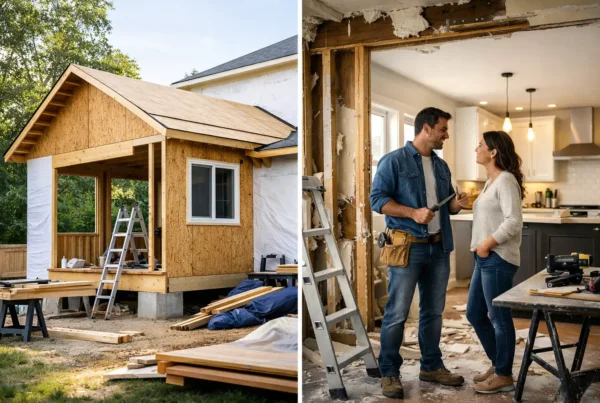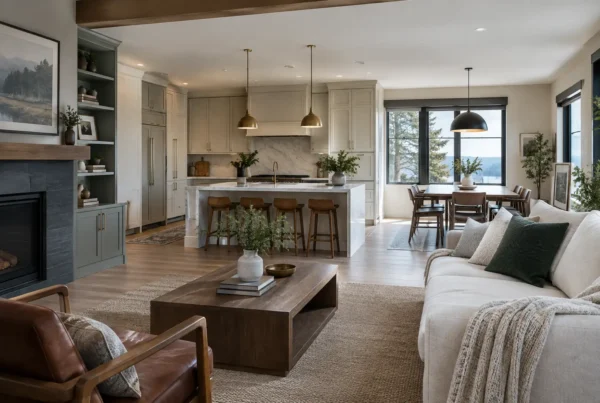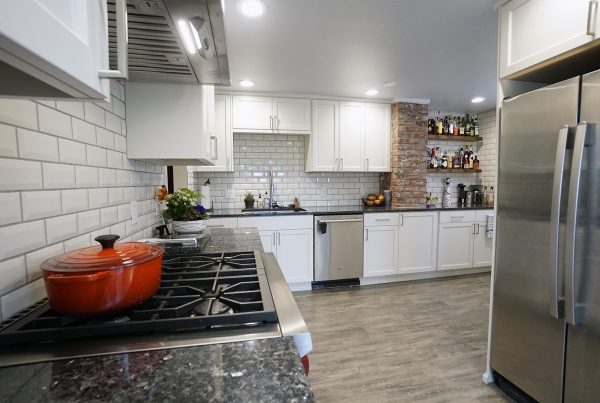
The first real decision in a whole-home remodel is not which room to start with. It is whether you are staying in the house.
Everything downstream turns on that answer. If the house will be empty, we sequence for efficiency: open everything at once, run all the trades in parallel, and finish in the shortest total stretch. If you are living in it — and in Seattle, with the cost and scarcity of somewhere else to be for months, most of our clients are — we sequence for livability instead. The work takes a different shape, and the plan has to protect a functioning half of the house at every moment.
Here is how that plan is actually built.
What genuinely cannot be phased?
We start here because this is where phased projects most often go wrong, and where optimistic promises are made.
Some work is house-wide by nature. An electrical service upgrade is one event, not four. If a 1920s house is coming off knob-and-tube, the rewiring crosses every wall cavity and every ceiling in the building, and doing it a quarter at a time means opening some walls twice. A failing plumbing stack runs vertically through the whole house. Structural work — a beam replacing a bearing wall, a foundation repair, seismic retrofit at the mudsill — does not respect room boundaries either. Neither does anything that changes the building envelope.
So the honest sequence starts with a house-wide systems phase, and that phase is the most disruptive stretch of the project. We tell clients that plainly at the outset, because the alternative is discovering in week three that the “we’ll do the upstairs later” plan was never available. What we can do is compress it, schedule it tightly, and know exactly when it ends.
After that, the project becomes genuinely zoneable, and that is where staying in the house becomes workable.
Which zone should go first?
Our rule is simple: you must always have one working bathroom, one place to sleep that is outside the containment, and some way to feed the household. The sequence is built backwards from those three requirements.
In practice that usually means the private zone gets resolved before the public one. Bedrooms and a bathroom are finished first, so there is a clean, quiet, dust-free half of the house to retreat into while the main floor is taken apart. In a two-story Seattle house that division is convenient, because the stairs give us a natural place to build the barrier. In a mid-century rambler, where everything is on one level, we look for a different seam — a hallway, a door, sometimes a garage that becomes a temporary living room for a while.
The kitchen goes into the loudest, longest phase and is usually not first. A kitchen under construction removes the room the household organizes itself around, so we want the rest of the plan stable before it goes out of service, and we want its cabinetry, appliances and stone already ordered and landed before demolition rather than arriving mid-build.
What we resist is sequencing by enthusiasm — starting with the room you are most excited about. That is the fastest route to a project where the exciting room is finished and then gets disturbed again by work that had to happen around it.
What is the order of work inside each zone?
Within a zone, the order barely varies, because each step depends on the one before it:
- Protection and containment go up before anything is touched.
- Demolition, and the discovery that comes with it.
- Structural work and framing changes.
- Rough mechanical, electrical and plumbing, then inspection.
- Insulation and air sealing, then inspection.
- Drywall or plaster repair, then priming.
- Millwork, cabinetry and trim.
- Tile and stone.
- Flooring, or refinishing of the original floors.
- Paint, then fixtures, lighting and hardware.
- Punch list and final walkthrough.
Original floors deserve a note of their own, because they are the most common sequencing mistake we are asked to fix. The fir floors in these houses are worth saving, and refinishing them is one of the last things that should happen — not because of the finish itself but because everything above them creates dust, drops things and gets walked over. When floors are refinished early to “get them done,” they spend the rest of the project under paper and still come out marked. A whole-house refinish also means the house is unwalkable for a stretch, which has to be planned into where everyone is sleeping.
How do you keep the finished half actually livable?
This is craft rather than paperwork, and it is a large part of what you are paying for in a whole-home project.
Containment is built, not draped — solid barriers with zippered access at the seams, sealed at the edges, so plaster dust does not migrate. That dust is the specific reason this matters here: the plaster-and-lath in older Seattle houses produces a fine, pale powder that travels through any gap it can find and settles on everything for weeks. Forced-air returns in the work zone get sealed so the furnace does not distribute it through the whole house. Stairs and paths get protected properly. Anything demolished leaves through a defined route rather than the living room.
The rest is logistics, agreed before day one: where the crew parks on a street that likely has no parking, where the dumpster sits, what time work starts, which door the crew uses, where the dog is, how the household knows what is happening in a given week. Our clients have one point of contact for all of it, which is a direct consequence of the design and construction being the same team rather than two companies with separate schedules. Our timeline guide covers how the phases stack up across a project of this size.
What has to be settled before the first day?
Everything that a later decision could disturb. For a whole-home project that list is long, and getting through it is exactly what our design phase is for: the full layout, structural strategy, every material in every room, all cabinetry and millwork drawn, the lighting plan, the phase map showing which zone is under work when, permits filed, and every long-lead item ordered.
Only then do we price it — as a fixed bid on a fully designed project, so that the number you see is the number, before you commit to construction. On a project measured in months, that matters more than on any single room. A whole-home remodel priced with allowances and open decisions is a project whose cost and schedule will both drift, and drift is what makes people move out of a house they meant to stay in. If you are earlier than this and still working out scope, our guide to whole-house remodels in older Seattle homes is the better starting point.
Living in a house while it is remodeled is entirely possible, and we do it with clients regularly. It just has to be designed that way from the beginning rather than improvised once the crew arrives. Show us your house and how your household moves through it, and we will build the phase plan around that before anything else. Start with our whole-home remodeling, then book a design consultation with NOR Design & Construction or call 206-979-3420 and we will talk through what staying would really look like.