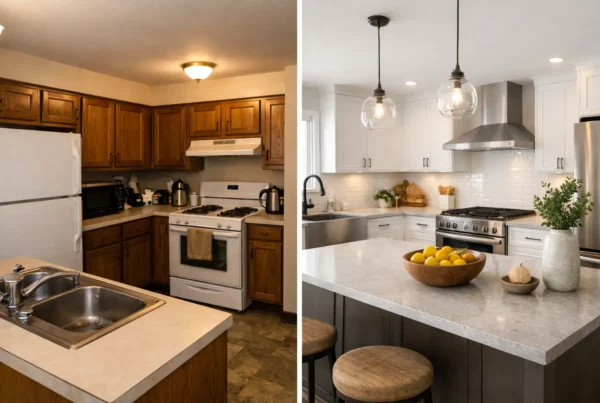
There is a real difference between a kitchen upgrade that impresses on the first walkthrough and one that is still earning its place on a wet Tuesday in February. Both cost money. Only one of them keeps giving something back.
After twenty years of designing and building kitchens in this city, we have a clear view of which is which. Some of what follows is unglamorous. All of it is what we would specify in our own homes, and most of it is invisible in a photograph.
What kitchen upgrades still feel worth it years later?
The pattern is consistent: the upgrades that keep paying are the ones that change how the room works every single day, not the ones that change how it looks on the first visit.
- Drawers instead of doors in the base cabinets. A base cabinet with a door is a cave. You kneel, you reach past the front row, you pull three things out to reach the fourth. Deep drawers bring the contents to you. This is the change our clients mention most often, and it is a design decision rather than an expensive one.
- A real landing zone beside the oven and beside the refrigerator. Somewhere to set the hot pan down and somewhere to set the grocery bags down. Kitchens that lack these feel wrong without anyone being able to say why.
- Storage designed around what you actually own. Not a catalog insert, but a measured place for the specific things in your kitchen — the sheet pans, the stand mixer, the recycling. We wrote separately about storage designed around how you really cook, because it rewards more attention than it usually gets.
- A quality faucet and valve. A faucet is touched more times a day than anything else in the kitchen. The mechanism inside it is what determines whether that still feels good in year eight.
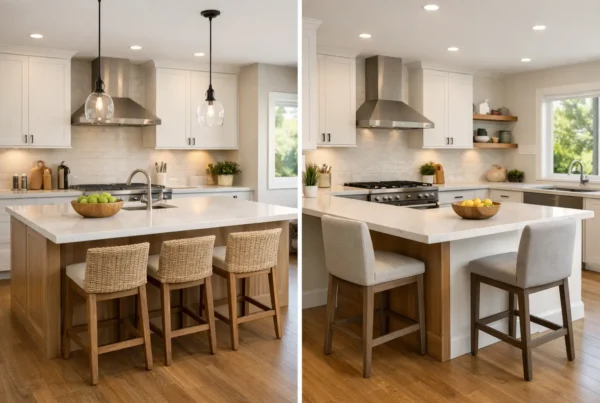
- Counter space where the work actually happens. More total counter is not the goal. Uninterrupted counter between the sink and the range is.
Why does lighting matter so much in a Seattle kitchen?
Because for a large part of the year, the daylight coming through a north-facing kitchen window in this city is not enough to cook by at four in the afternoon. That is not a complaint about the weather — it is a design constraint, and it is one of the clearest places our interior design background changes what we specify.
A single fixture in the center of the ceiling puts your own shadow on the cutting board. What works instead is layered: task light under the upper cabinets falling directly on the counter, general ceiling light placed over circulation rather than over your back, something warm over the island or table that makes the room feel like a place to sit, and dimming on separate controls so the kitchen can be bright at seven in the morning and low at nine at night.
We also pay attention to color temperature, because a gray winter afternoon reads cold and the light in the room has to do the compensating. Getting this right costs a fraction of what cabinetry costs and changes the room more. Our longer piece on kitchen lighting for gray Seattle winters goes through the layers in detail.
Is a real ventilation system worth the money?
Yes, and more here than in a dry climate. In a house that is closed up through months of damp weather, cooking moisture has nowhere to go. It condenses on windows, it settles into cabinet finishes, and over years it does quiet damage in the places you cannot see.
A properly sized hood, ducted to the exterior on the shortest sensible run, with a make-up air strategy where the appliance requires it, is the upgrade people are least excited about and most glad they made. A recirculating hood filters odor and does essentially nothing about the moisture. When a duct run is genuinely impossible we will say so and design around it, but we will not pretend the two are equivalent.
What about the parts we cannot see?
In the older houses across West Seattle, Wallingford, and Queen Anne, the kitchen is usually the room where a hundred years of incremental electrical work has accumulated. Circuits added for a dishwasher in one decade and a microwave in another, remnants of knob-and-tube wiring in the ceiling, and a panel that was sized for a house with far fewer appliances in it.
Bringing the electrical up to what a current kitchen actually needs is not an upgrade anyone dreams about, but the moment the walls are open is the only affordable moment to do it. The same logic applies to plumbing supply lines, to any framing that has been notched badly over the years, and to insulating an exterior kitchen wall that has never had any.
We handle these during design rather than discovering them mid-build, because a surprise in week three of a kitchen remodel is expensive in both money and calendar. Finding it during design means it is drawn, priced, and included in the fixed bid you see before construction begins.
Which upgrades photograph better than they live?
We will be direct, because this is the part most articles skip.
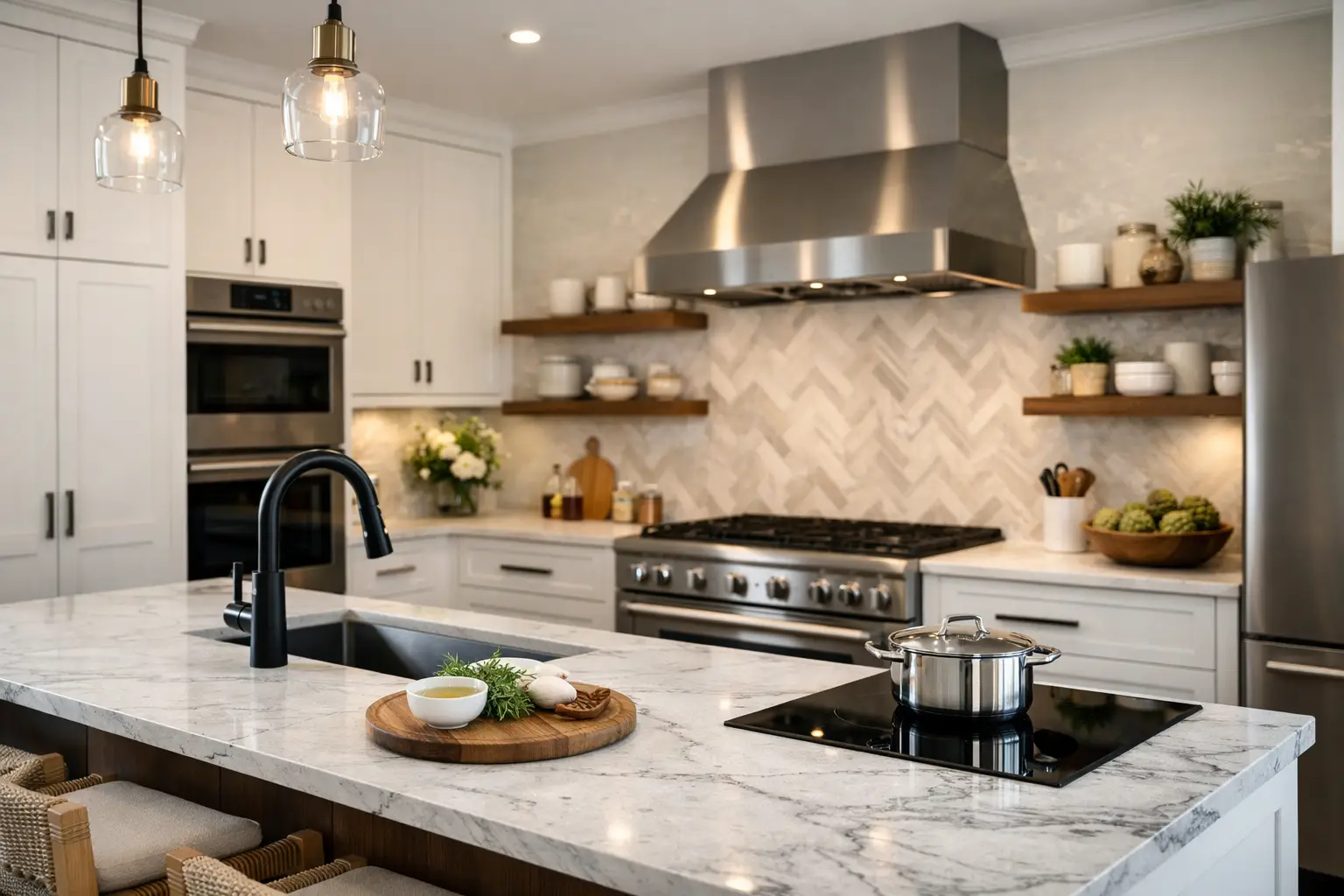
Highly specialized appliances that serve one narrow purpose tend to become expensive cabinet space. Open shelving above a working range collects a film of cooking residue that has to be washed off, not dusted off. Very heavily veined slabs are beautiful and also unforgiving of any future repair or seam. Intricate decorative tile detail behind a cooktop looks superb until you clean it weekly. Ultra-matte finishes on high-traffic cabinet doors can hold hand marks in a way a satin finish does not.
None of these are wrong. Several of them are right for the right household. Our objection is to choosing them by image rather than by how the room gets used on an ordinary morning — and asking that question honestly is exactly what our design phase is for.
The other thing worth saying plainly: an upgrade only pays off if the layout underneath it is sound. Better appliances in a kitchen where the traffic path runs straight through the work triangle will not fix the kitchen. The plan comes first, and everything on this page is second.
If you are deciding where the money should go in your own kitchen, that is a conversation worth having in the room itself. A design consultation with NOR Design & Construction starts with how you actually use the space, and ends with a design and an exact price rather than a wish list. Book a consultation, or call us at 206.979.3420.