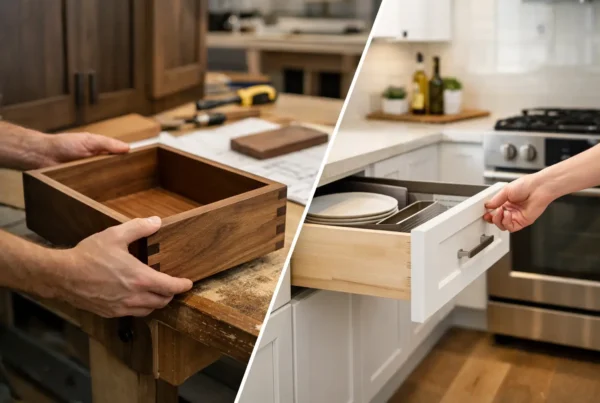
Two kitchens can photograph identically. Same painted inset doors, same white oak island, same hardware. Open a drawer in each of them, pull it all the way out, and you are looking at two entirely different products. One drawer box is a solid, dovetailed thing that glides to a stop and holds a stack of cast iron without complaint. The other is stapled at the corners, rides on a slide that gives up an inch short of the back, and will start to rack in a few years.
Nothing on the outside told you that. This is the single most confusing thing about cabinetry for homeowners, and it’s the reason two bids for what looks like the same kitchen can be far apart with neither of them wrong. What follows is what we look at, and what we specify, when we draw a kitchen.
What’s actually holding the box together?
The carcass — the box itself — is the part nobody sees and everything depends on. Plywood boxes are stiffer, hold fasteners better, and tolerate the odd plumbing leak under a sink far better than particleboard. Thickness matters too: a three-quarter-inch side panel behaves differently from a half-inch one under a heavy stone counter, particularly on a long unsupported run.
The joint is the other half of the answer. Sides joined into machined grooves, glued and clamped, stay square. Sides butted and stapled do not, and once a box goes out of square, the doors on it can never be made to line up again. Look at the back panel while you’re in there. A full-thickness back that carries structure is different from a thin sheet tacked on to keep dust out, and it’s the difference between a cabinet that stays rigid when it’s screwed to an out-of-plumb wall and one that twists to match.
Framed or frameless — will I notice the difference?
Every day, yes. A framed cabinet has a face frame across the front of the box, which is stiff and forgiving and traditional. It also narrows the opening, so drawers inside a framed cabinet are meaningfully smaller than the cabinet is wide. Frameless cabinets skip the frame, which gives you the full interior width and a cleaner run of doors — at the cost of demanding much tighter tolerances, because there is no frame to hide behind.
Neither is better in the abstract. In a 1920s Craftsman with painted inset doors, a face frame is the honest choice and it matches how the rest of the house is built. In a mid-century remodel with long horizontal runs, frameless is usually the right call. What we won’t do is pick one because it’s what a particular line happens to offer. The construction should follow the design, which is why the decision sits inside the design phase rather than at an order deadline — and it’s closely tied to whether custom or semi-custom cabinetry is the right route for your kitchen.
Why do inset doors cost more?
Because tolerance is expensive. An overlay door sits on top of the frame and hides its own alignment; you can be a little off and no one can tell. An inset door sits flush inside the opening with an even reveal all the way around, and every deviation is visible from across the room.
Wood also moves, and here that becomes a Seattle question. Our winters are long and damp and our summers are dry, and solid wood door components respond to that swing across the year. A well-built inset door is engineered for it — stable core materials where they belong, a five-piece door with a floating center panel, hinges that can be adjusted in three directions. A cheaply built one closes fine in October and binds in March. When we specify inset, we specify what makes it survive the seasons here, not just what it looks like on delivery day.
What are the drawer boxes and hinges really worth?
More than almost anything else on the list, because they are the moving parts and moving parts are what fail. A dovetailed hardwood drawer box with an undermount, full-extension, soft-close slide is a component you will operate several times a day for twenty years. Full extension is the part people underestimate: without it, the back several inches of every drawer is functionally storage you have to reach blindly into.
Hinges are the same story on a smaller scale. Six-way adjustable hinges mean a door that goes out of alignment can be brought back with a screwdriver instead of being lived with. Weight rating matters on tall pantry doors and on any drawer that will hold plates. When we look at a competing bid for a client and it comes in noticeably lower, this is often where the difference actually lives — not in the door style anyone is discussing.
How does the finish change what I live with?
A factory-applied catalyzed finish is cured, not just dried, and it resists the things kitchens do to painted surfaces: grease, steam, cleaning products, fingernails on a drawer edge. A finish applied on site in an occupied house cannot achieve the same conditions, and it shows up as wear around the handles within a couple of years.
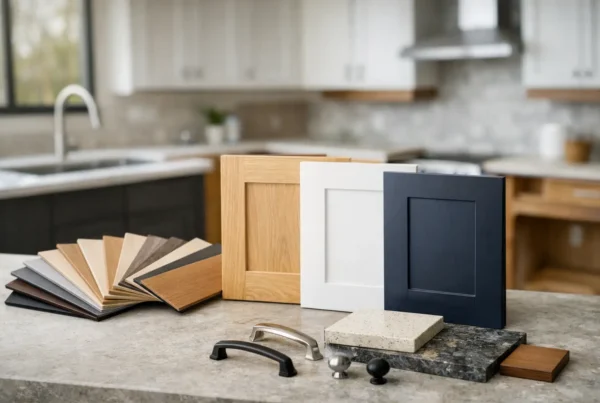
The trade-off is honest. A cured factory finish is much harder to touch up later, because you cannot blend into it. Which is why painted doors that are going to take real abuse get specified with stable center panels rather than solid wood, why we think carefully about sheen — a dead-flat paint shows every handprint, a high gloss shows every ripple in the substrate — and why the door style, the finish and the hardware get decided as one set. Those are the choices you touch, and we cover them separately in door styles, finishes and hardware.
Does installation belong in this conversation?
It belongs at the center of it. In the older houses we work in across West Seattle, Ballard and Wedgwood, almost nothing is square. Plaster-and-lath walls have thickness that varies along a run, floors slope a little toward the middle of the house, and ceiling heights are not the same at both ends of a kitchen. Beautiful cabinets installed against that reality without proper scribing, shimming and filler planning will read as slightly wrong, and no one will be able to say why.
Because we design and build, the person drawing the run and the person hanging it are on the same team, and the site conditions are measured and drawn before anything is ordered. That is also what lets us put cabinetry into a fixed bid as a specified product — a named construction, a named finish, named hardware — rather than as an allowance that shifts once real selections are made. Every kitchen remodel we take on is priced that way at NOR Design & Construction: design first, then an exact number.
If you’re holding two cabinet quotes and can’t work out why they’re different, bring them to us and we’ll show you what each one is actually describing. Then we’ll design your kitchen properly, specify the construction line by line, and price it once. Book a design consultation or call 206.979.3420.