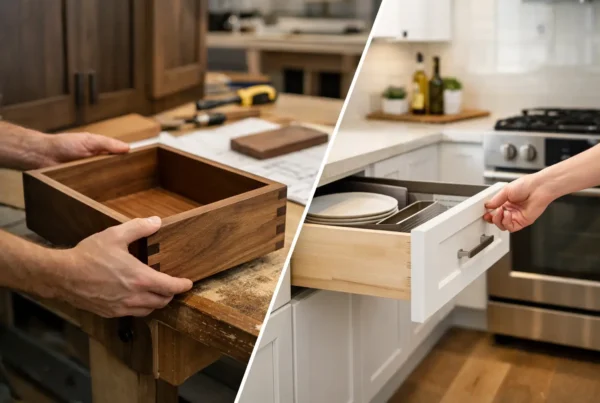
Open a drawer in a 1940s kitchen in Wedgwood and you can usually tell within about four seconds. If it glides on a wooden runner worn smooth by eighty years of use, and the box is solid, and the whole thing sits square in an opening that was built in place by a carpenter standing right there — you may be looking at something worth keeping. If it drops on its nose when you pull it out and the bottom panel is a sagging sheet of hardboard, you are looking at something worth removing.
Keeping existing cabinets is one of the few genuine savings available in a kitchen remodel. It is also one of the easiest places to spend real money on a result nobody is happy with. The difference comes down to a handful of questions we ask in the first half hour of walking a kitchen.
How do I tell if my cabinets are actually good boxes?
Ignore the doors. Doors are the cheapest thing to change and the thing everyone judges by. What matters is the box behind them.
- What is the box made of? Plywood or solid wood carcasses can be reworked, refinished and rehung. Particleboard with a printed laminate face cannot take much, and it will not hold a hinge that has already been re-drilled once.
- Is it square, level and solid? Push on a run. If the boxes rack or the face frames have opened at the joints, new doors will hang badly no matter how good they are.
- How are the drawers built? Dovetailed or well-joined drawer boxes are worth saving. Stapled boxes with a nailed-on bottom are not.
- Is there water damage? Look hard at the sink base, and at the base cabinet beside the dishwasher. A slow supply line or a failed dishwasher gasket can quietly ruin the bottom of a cabinet, and in our climate that damage does not dry out and stop — it keeps going.
- Are the interiors usable? Fixed shelves, no drawer bank, a dead corner you have to lie on the floor to reach. A good box with a hopeless interior is only half a saving.
If the boxes pass, you have real options. If they fail on construction or on water, the conversation is about new cabinetry, custom or semi-custom, and pretending otherwise just delays it by a year.
What does refacing change, and what does it leave alone?
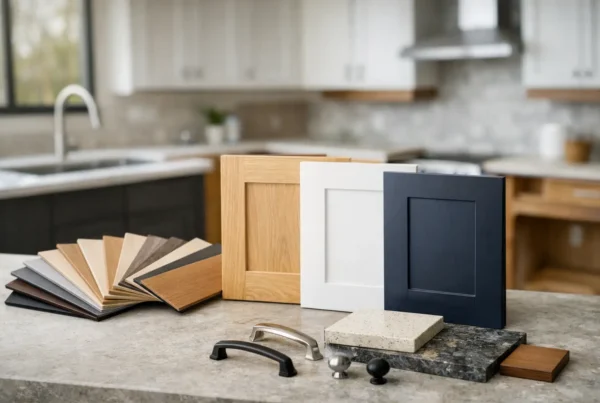
Refacing replaces the doors and drawer fronts and applies a new veneer or paint-grade skin to the exposed face frames and end panels. New hinges and hardware go on. What you see changes almost entirely.
What does not change is everything behind the face: the cabinet sizes, the layout, the interior configuration, the position of the sink and the range, the toe kick height, the dead corner. Refacing is a cosmetic operation on a structure you are agreeing to keep. That is a perfectly good decision when the structure is good and the layout works. It is a poor one when the reason you want a new kitchen is that the kitchen does not function.
When does refacing cost more than it saves?
More often than people expect, and it usually happens for one of these reasons.
When the layout has to change anyway. The moment the sink moves, a wall opens, or the refrigerator relocates, some cabinets come out. Now you are refacing part of a kitchen and building the rest, and you are asking a fabricator to match a new door, a new finish and a new profile to an eighty-year-old face frame. Matching is expensive and it is rarely perfect. Two-thirds of a kitchen at the price of new cabinetry is a bad trade.
When the cabinets were built in place. Plenty of pre-war Seattle kitchens have cabinets that were framed and scribed into plaster walls on site. They are not units; they are part of the house. They cannot be pulled, modified and reset the way a modern box can, and they often cannot be adjusted at all without opening the plaster around them.
When there is water or pest damage. A rotted sink base means the cabinet, the floor beneath it and often the subfloor. Skinning the front of that does not solve anything.
When the finish work outruns the savings. Old cabinets get refinished, and refinishing is labor. Stripping, filling, sanding, priming and spraying a full kitchen’s worth of face frames on site — in a room that has to be masked off and ventilated, in a wet climate where cure times matter — adds up fast. There is a point where the labor to make old boxes look new approaches the cost of boxes that are new, and we will tell you when we think you have reached it.
Does keeping the cabinets lock in the old layout?
Largely, yes. That is the honest trade-off, and it is worth thinking about carefully, because layout is the thing you feel every single day. A kitchen where the dishwasher swings into the walking path, or the only counter is on the wrong side of the range, or two people cannot pass, will still do all of that in a new finish.
Our training is in interior design, so we look at this first: how you cook, where the groceries come in, where somebody stands with a coffee while somebody else makes breakfast. If the layout is genuinely good and just tired, keeping the boxes is a smart, restrained decision, and we will happily design around it. If the layout is the problem, refacing spends money on the wrong thing. That judgment is the core of how we approach a kitchen remodel before any material gets discussed.
What if only part of the kitchen is worth keeping?
This is often the right answer, and it takes design to pull off rather than a patch. A common version: keep a run of well-built original uppers along one wall as a deliberate feature, refinish them, and build everything else new in a complementary finish — not a failed match, an intentional contrast. Another: keep the boxes but rework the interiors entirely, adding drawer banks, a pull-out beside the range, proper corner access. That is a real upgrade to how the kitchen works without replacing the shells.
One practical note about older houses. Cabinets that have been in place since the 1930s or 40s are often sitting on unfinished original fir, with the finished floor running only up to their toe kick. Remove or shift them and you find bare wood in the shape of the old cabinet run. That is a solvable problem, but it is a floor decision hiding inside a cabinet decision, and it should be on the table before anyone commits to a plan.
When we assess cabinetry at NOR Design & Construction, we work all of this out during design and put the answer in a fixed bid — including whether keeping your cabinets truly saves you anything. If you want more detail on what separates a good box from a poor one, our guide to cabinet construction covers it.
Not sure which side of the line your kitchen falls on? Let us come look at it. We will open a few drawers, check what is behind the doors, and give you a straight answer about whether your cabinets deserve a second life or a respectful exit — then design around whichever it is. Reserve a design consultation, or ring us at 206.979.3420.